


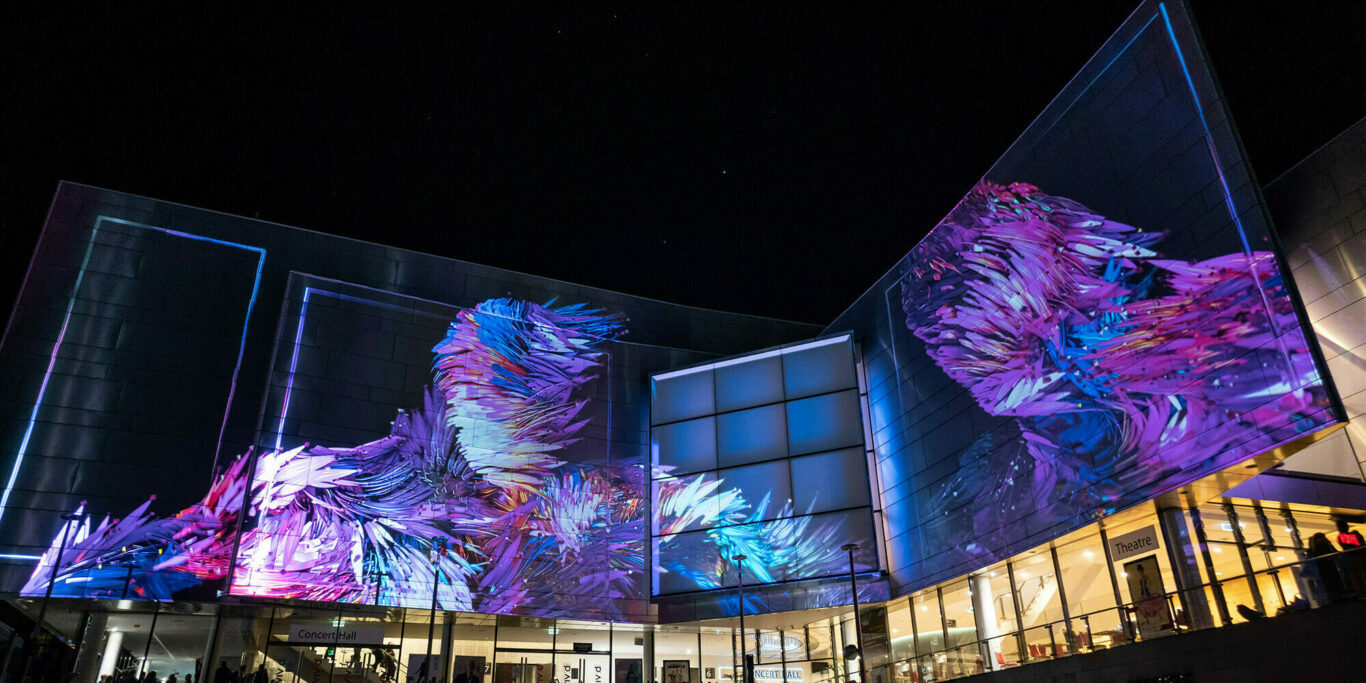
In early April, the Video Mapping Festival took to the streets of Lille. For 2 nights, the walls of some of Lille’s most emblematic monuments were used as projection surfaces, offering passers-by audiovisual creations directly broadcast into the public space ( 250,000 spectators). On the Thursday and Friday preceding this public event, theIBSIC – Image Beyond the Screen International Conferencean annual international meeting dedicated to the video-mapping industry, brought together over 400 professionals from all over the world: artists, creative studios, local authorities, festivals and venues. Following the active participation of the {CORRESPONDANCES DIGITALES] team in this event, this article is an opportunity to share some thoughts on the changes currently taking place in the video-mapping industry, inspired by this event. These changes include the development of video-mapping projects in heritage sites, the evolution of artistic festivals and the repositioning of artists and creative studios towards new approaches.
Developing video-mapping projects at heritage sites: from large-scale shows to seasonal or even permanent programming
By summer 2023, no fewer than 114 video-mapping in France (a 30% increase in the number of video-mapping shows compared to 2022).
Generally deployed in public spaces and commissioned by local authorities to animate and enhance their territory and emblematic monuments, more and more places are developing their own shows. Such is the case with heritage sites (churches, castles, archaeological sites, etc.), which are increasingly involved in developing projects to enhance their nocturnal appeal through video-mapping. These shows can be offered on a temporary basis to commemorate major events, or on a semi-permanent basis (for the duration of a season) to provide an attractive nocturnal offering that complements daytime visits.
From the creation of large-scale shows…
In terms of large-scale spectaculars, like other forms of celebration involving fireworks, sound and light, the commemoration of events is an opportunity to call on video-mapping artists. So, in 2023, the Mont-Saint-Michel teams decided to mark the abbey’s millennium with a high-quality sound and light show. Produced by ateliers BK, projections on the history of the abbey were created over the course of an evening on the facades, complemented by a choreography involving almost 400 drones. The project was financed 75% by the Centre des Monuments Nationaux and 25% by the Établissement Public National du Mont-Saint-Michel, for a total of 200,000 euros. Over 15,000 people attended the event.

These shows can also be programmed over longer periods. Chartres en Lumières has taken up this challenge with a 9-month program. A tour of the city featuring 21 illuminated sites to visit freely attracts over1 million visitors a year. Designed to attract visitors and increase the number of overnight stays for tourists, the route is also the subject of paying guided tours operated by the Tourist Office, offering a different way of discovering Chartres by night. Every year, new works of art are added to the program. In 2025, 3 new scenographies are scheduled, including one on the Notre-Dame de Chartres cathedral to celebrate the 1000th anniversary of its crypt. The budget for this program is estimated at between 800,000 and 1 million euros, including 380,000 euros for equipment renewal.

… Through the emergence of shows on the scale of a heritage site
Such shows are also available on a monumental scale. Immersia Production proposed an indoor show in the church of Notre-Dame de Bon-Port from November 2024 to March 2025. For 45 minutes, spectators were immersed in a three-act maritime odyssey, a metaphor for an inner voyage, alternating between open horizons and inner storms. Some of the shows even included live performances, interweaving various digital and auditory arts to reinforce the sense of immersion. Over 20,000 spectators attended this premiere, testifying to the public’s enthusiasm for this immersive art form combining technology and heritage. Tickets, available online only, were priced from €16.

… to enriching the permanent itinerary of a heritage site by creating immersive “indoor” experiences.
To conclude this overview, some heritage sites have chosen to develop a program that is fully integrated into their permanent itineraries, accessible mainly during the day. This is what the Palais des Rois de Majorque in Perpignan has been offering since 2021, with a 12-minute experience that brings to life the four seasons of the Palace’s gardens. The show was produced by Opixido (graphic design), Les Fées Spéciales (animation studio) and artist-directors Maud Sertour and Samy Barras. The “illuminated gardens” were financed to the tune of 250,000 euros by the département. This is also what the DEM Museum in Istanbul, Turkey, offers. At the last edition of IBSIC, this Turkish cultural agency highlighted three immersive sites recently opened or in the process of being opened in Turkey: Ephesus, Hagia Sophia and Hierapolis. Finally, also present at IBSIC, the Dali Museum has created a permanent installation in 2023 to immerse visitors in the surreal world of Salvador Dalí. Dali Alive 360° features a combination of 360° projections, immersive sounds and animations in the Dalí Dome (an 18-meter-high geodesic structure specially designed for this exhibition). The show, which lasts around 40 minutes, retraces the different periods of the artist’s life, from his childhood in Spain to his years in Paris and America, for an additional $15 on top of the admission ticket.


The diversity of these examples demonstrates the vitality of heritage sites in embracing these experiences as part of their temporary, seasonal or permanent programming. A previous article we wrote last year looked at the development of such proposals within their walls.
Other players, such as video-mapping festivals with a long-standing commitment to the dissemination of high-quality works, are increasingly involved in synergistic approaches to networking and touring their projects.
Festivals dedicated to video-mapping creations: from a competitive logic to a logic of itinerancy, networking and sustainability
Beyond the spectacular approach dedicated to enhancing heritage sites, the video-mapping sector is rich in festivals highlighting the beautiful artistic creativity of this field. These festivals are increasingly recognized both for their popular success and for the artistic quality of the works they host (video-mapping works as well as digital-light installation works). By 2024-2025, there will be more than 39 festivals will be held across Europe, including the video mapping festival in Lille, the Lyon’s Fête des Lumières (now in its 25th year, it has attracted over 2 million visitors) or the Constellations international festival in Metz (nearly a million spectators in 2024).
These festivals are rooted in a wide variety of dynamics: the touring of works to other venues, increasingly close international networking, and the perpetuation of projects in dedicated venues.
Touring works to other venues
The video-mapping festival is held in Lille at the beginning of April, but the festival also takes place in some twenty towns in the Hauts-de-France region over a six-month period (from April to October 2025). The festival will be held successively in Harnes & Mazingarbe, Amiens, Arleux, Béthune, Calais, Dunkerque, Lannoy, Lauwin-Planque, Le Crotoy, Lille, Lomme, Mers-les-Bains, Péronne-en-Mélantois, Quiévrechain, Raismes, Roubaix, Sailly-sur-la-Lys, Saint-Omer, Tourcoing, Valenciennes, Wallers-Arenberg, Wormhout and Yvrencheux. From the facade of a belfry to that of a high school, from an administrative building to a listed monument, the festival transforms each location into a medium for artistic expression, and, through this itinerancy, builds strong links with the local area. Each commune is involved in the selection of venues and, in some cases, in the creation of the works via participatory workshops. The Rencontres Audiovisuelles teams in charge of the festival are firmly rooted in their region and in the people of the Hauts-de-France region, and are also strongly committed to international programs such as Co-Vision.

International festival networking
At a European level, festivals are showing their willingness to team up to help structure the industry, support artists and accelerate the circulation of mapping works. This is the background to the Co-vision program. Funded by the European Union, 11 cultural and academic structures (7 festivals and 4 technical partners) from 11 European countries have been involved for several years, through conferences, debates and the touring of works at festivals such as Signal in Prague, Kikk in Namur and Videoccittà in Rome.

To reinforce this dynamic and strengthen their local roots, some festivals also set up their own venues. This is the case for Signal and Kikk in Belgium.
Rooms specially opened for video-mapping
Bolstered by their public success, some festivals are now looking to open their own immersive theaters. Such is the case of Prague’s Signal Festival, billed as one of the must-see events of the autumn.

In addition to their role as venues, these festivals are also dedicated to welcoming professionals and artists through workshops and residencies. In a few months’ time, Rencontres Audiovisuelles, an initiative of the Video Mapping Festival, will be opening a broadcasting and residency facility dedicated to these forms of creativity. This venue will be in line with the residency policy already implemented within the framework of the festival with initiatives such as VideoMap, a cooperation project between Wallonia and the Hauts-de-France region supported by the European Union (Interreg program). The VideoMap project organizes writing and production residencies every 6 months for 3 years (until 2028), alternating between Wallonia and Hauts-de-France. The productions produced are then distributed in both regions.

These different examples illustrate the diversification of festival approaches to increase cooperation, consolidate relationships and promote the distribution of the works they represent. This distribution strategy is also increasingly adopted by artists and creative studios themselves.
The place of creative studios and artists: between professionalization, structuring and partnerships
The development of calls for projects and residency policies by festivals, the rise of distribution venues (dedicated cultural sites or public spaces), and even distribution platforms dedicated to digital works are all dynamics that encourage artists to build up their expertise in order to create, but also to find ways to finance themselves, distribute their works, and even exploit their own projects. Faced with these developments, artists are building up their skills in new areas, forming collectives or creative studios, or developing partnerships with producers or distributors.
Move from a logic of creating experiences or exhibitions to a logic of production and distribution (from touring to festivals, or even dedicated venues).
To promote their creations, more and more artists are organizing themselves to become producers and distributors of their own projects. Starting from formats that are, in essence, situated and unique (video-mapping works are characterized by a perfect adaptation of the projected image to the surface that hosts it), these artists turn their works into shows, experiences or exhibitions that can be more easily hosted in a variety of venues. This formal possibility requires, however, that such creations be produced, financed, distributed and even exploited.
On the exhibition front, the Anima Lux studio, for example, designed and produced PRISM with Yann Nguema. Presented at the Champs Libres in Rennes between October 2023 and March 2024, this immersive exhibition attracted some 45,000 visitors. Following its run in Rennes, the exhibition will travel to other cultural venues in France and abroad. In April 2025, it was hosted in the Drôme region, at the L’Artsolite contemporary art center.

On the experimental side, some artists are committed to the idea of adapting their work to different formats with each new creation, in order to speed up distribution. This is the case, for example, of Jérémy Oury. Some of his works, intended for architectural video-mapping, are then declined in 360° to facilitate distribution in geodesic domes or planetariums. By way of example, his full-dome mapping project Phosphene won the Best Dome Short Film award at HIFF in the USA in 2022.
TheSous dôme festival is another logical venue for the festival. It is co-organized by 36 Degrés, Jeremy Oury and the Cité des Sciences et de l’Industrie in the planetarium of the Cité des Sciences, an event dedicated to geodesic projection. These creative approaches to art, science and technology are also supported in France by the Pôle Aadn, which regularly offers calls for projects, residencies and support to artists wishing to perform under domes and in planetariums.

Finally, as with festivals, creative studios such as OCUBO are opening their own immersive rooms. The studio recently opened the Immersivus Gallery in Lisbon and Porto.

Beyond this diversity, a further step in the consolidation of the industry has been taken with the creation of platforms dedicated to the distribution of immersive works in public spaces.
Towards a platform for distribution? The case of D’stric’s LED.ART project t
At the last edition of IBSIC, we had the pleasure of interviewing the Korean agency D’strict about this approach. On the strength of some very fine creative projects in public spaces, but also following the development of a network of immersive rooms (20 sites opened or in the process of being opened around the world) and collaborations(such as the one recently completed with the Musée d’Orsay), the Korean company has decided to launch a new platform: LED.ART.

Backed by its distribution network, this platform references the creations of various artists and distributes them to venues and public spaces looking for creative projects to liven up their spaces. A licensing logic applies to each distribution of works. A further step towards the industrialization, commercialization and distribution of creative and artistic works.
Initially confined to one-off outdoor events, video-mapping is now a permanent fixture in venues, diversifying in terms of formats, media and production methods. Thanks to the momentum generated by venues, festivals and artists themselves, video-mapping is changing, diversifying, expanding and spreading. It’s a creative sector that’s bursting at the seams, opening up exciting prospects for reaching out to new territories and new audiences.
Charlotte BAUGE and Antoine ROLAND