


For this edition of NUMIX LAB 2025, under the theme “Beyond the boundaries”, we are offering a series of feedback conferences entitled“What’s New?“, providing a panorama of innovations in the immersion, digital art and cultural heritage sectors in Europe, Canada and the United States. Discussions focused on four main themes: the evolution of new permanent immersive venues (museums, labs), the growing role of digital art festivals as platforms for critical experimentation and investment in public space, the integration of digital technology within museum institutions to meet logistical challenges and strengthen community involvement, and finally, the articulation between the arts, science and technology within creative labs, particularly in the face of the challenges of accessibility to complex data and the fight against the digital divide.
Throughout our event, panels dedicated to the major themes of this year’s theme were a source of sharing and inspiration: new cultural venues, artistic and cultural hybridity, youth and immersive audiences. Read the presentations HERE. You can also discover all the content from the workshops held during this 6th edition of NUMIX LAB. Various workshops were organized on the future of museums (led by Museum Booster), the distribution of immersive works (by the Grand Palais immersif), international networks and cultural centers (by the Institut Français) and Europe Creative programs (by the Media Desks of Hungary and Luxembourg). Find out more about the Workshops HERE.
Tuesday, December 2: IMMERSIVE VENUES

Denys Lavigne (President, Executive Creative Director and co-founder of OASIS immersion) moderated the meeting dedicated to new immersive venues, bringing together players from Spain, the Netherlands and Bulgaria.
This first What’s New session of the NUMIX LAB was inaugurated by the group Mediaproa European audiovisual structure.
Antoni Gaudí: The unseen experience – Mediapro
Alba Collado Forcadell (Director of Distribution at Mediapro) took the floor to introduce Mediapro, a company with over 30 years’ experience and a global presence spanning 52 cities. In addition to its traditional production and media services activities, the group is now distinguished by its division Mediapro Xperiencesdivision, specifically dedicated to the design and operation of exhibition spaces and cultural events.
The talk highlighted a long-awaited major project: “Antoni Gaudí: The unseen experience”. Scheduled for September 2026 in Barcelona, to mark the centenary of the architect’s death, this exhibition has been declared an “Event of Exceptional Public Interest” by the Spanish Ministère de la culture. The mission of this ambitious project is to take Gaudí beyond his legend, inviting the public to experience his work through cutting-edge technologies and discover the artist’s lesser-known facets. By combining mixed reality, virtual reality and interactive immersive spaces, Mediapro promises to offer a new perspective on the world’s most-visited architect.

This desire to renew our view of heritage through immersion is also reflected in the approach of Entr. in the Netherlands. However, where Mediapro explores the historical depth of a figure like Gaudí, Vincent Slangen favors a more raw, instantaneous immersion, aiming to capture the essence of a past atmosphere from the very first seconds of the experience.
Entr. (Netherlands) and the immersive experience: from immediacy to heritage memory
Representing the Dutch company Entr., Vincent Slangen (Founder of Entr.) delivered an outstanding presentation, built around a strategic vision focused on the immediacy and intensity of the immersive experience. His presentation highlighted the crucial importance of the instant impact felt by visitors, an approach he summed up in this powerful phrase in Dutch: “Op het moment dat je binnenkomt wil je gelijk alles zien” (The moment you enter, you want to see everything immediately).
Vincent Slangen’s presentation was not just theoretical; he also put this philosophy into perspective with a description of one of the Dutch organization’s flagship projects, the immersive installation ” 1675 The botermarkt “. This ambitious project, centered on the sensory reconstitution of a historic market, perfectly illustrates Entr.’s approach to immersing visitors from the very first moment. The aim is to go beyond simple historical narration, to create an atmosphere that maximizes the emotional and memorial impact of the experience.
Finally, to round off this tour of Europe, What’s New? welcomed a pioneering project from Sofia, offering a rich cultural program with a strong involvement in the life of Sofia and its population: the immersive Videnie room, from Studio Phormatik.
Videnie (Bulgaria): The rise of Bulgarian immersive art by Studio Phormatik
Launched by Vladislav Iliev and Studio Phormatik, Videnie is a new immersive art space located in the center of Sofia, Bulgaria. Its name, meaning “apparition” or “vision”, reflects its dual nature: a bold perspective on the future of art and a spiritual dimension to the artistic experience. Conceived as a 150 m² sensory laboratory, Videnie incorporates cutting-edge technologies, including 12 laser projectors, high-resolution LED screens and a unique vibroacoustic floor, enabling visitors to physically feel the sound. The aim is to break down the traditional barrier between work and audience, transforming the viewer into a fully immersed participant in a dynamic visual and aural narrative.

Videnie’s ambition is to transcend the mere exhibition space and become a driving force in the cultural landscape. Firstly, it aspires to establish itself as a leading national and international cultural hub for digital and immersive art, attracting local artists and international creators alike. Secondly, Videnie plans to launch an annual immersive art festival, aiming to become a major platform for exchange and experimentation. Finally, the project is committed to the education of the future with the development of specialized programs, including the Videnie KIDS initiative, to playfully connect art, technology and education with young audiences.
After exploring the evolution and ambitions of new immersive venues in Europe – from Mediapro’s historical and technological approach to Gaudí, to the sensory immediacy favored by Entr. and the spiritual and educational dimension of Videnie in Bulgaria – the focus shifted from permanent venues to dynamic events. Wednesday’s event focused on the crucial role of digital art festivals, highlighting their ability to use public space and existing architecture to democratize art and take a critical look at the digital age.
Wednesday, December 3: FESTIVALS
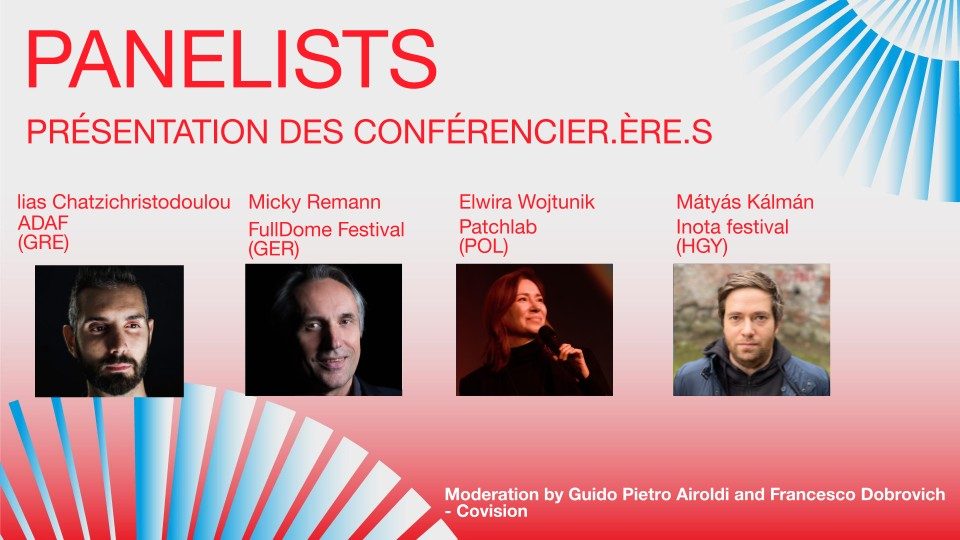
The meeting, moderated by Francesco Dobrovich , Creative and Strategic Director, and Guido Pietro Airoldi , International Development and Creative Consultant for Videocittà, highlighted the diversity of the European digital art scene. As an introduction, the moderators presented the Co-vision project, an initiative co-funded by the European Union to map natural heritage through digital archives, illustrating how festivals can collaborate across borders to create shared narratives. The first What’s News? was dedicated to one of the pioneers of digital art festivals: the Athens Digital Art Festival.
Athens Digital Art Festival: Twenty years of digital art and democratization in the public space (Greece)
The first talk took the audience to Greece, with a presentation of theAthens Digital Art Festival (ADAF), which recently celebrated its 20th anniversary. Ilias Chatzichrisodoulou (Vice-President of the festival) underlined the central mission of the event: to invest public space in order to democratize access to digital art. He illustrated this approach with some striking projects, such as the monumental mapping projected onto the neoclassical façade of the Athens Academy, or the development of the ADAF AR application. The latter superimposes augmented reality works on the urban fabric, creating a unique visual dialogue between the city’s omnipresent antiquity and futuristic technologies.

The discussion then shifted from the context of the digital art festival to Germany and the specific architecture of the fulldome.
Fulldome festival: storytelling and creativity at the heart of domes (Germany)

Micky Remann presented the FullDome Festival a unique event held at the Planetarium Zeiss in Jena, the world’s oldest surviving projection planetarium. Micky Remann’s focus is on the fundamental change in perspective offered by the dome: viewers no longer look at a frame in front of them, but are physically inside the image. He described the festival as a veritable laboratory for immersive media, highlighting the “Janus Awards” for excellence in the creation of fulldome content, constantly pushing back the boundaries of spatial storytelling.
While the FullDome Festival explores new sensory frontiers by physically placing the spectator at the heart of the image, other European events choose to use these technologies as a mirror of our society. Such is the case of the Patchlab Digital Art Festival in Krakow which, while using immersive formats, goes beyond technical prowess to transform the artistic experience into a veritable critical laboratory on our digital age.
Patchlab Digital Art Festival (Poland): When art deciphers the digital age in Krakow
The Patchlab Digital Art Festival, directed by Elwira Wojtunik (Artistic Director and Head of Programming) in Krakow, positions itself as a major event at the intersection of art, technology and science, with the primary aim of examining the impact of the digital on contemporary life. Far from being a simple exhibition, Patchlab functions as a critical laboratory, offering a diverse program including thematic exhibitions – such as “Realities” exploring VR, AR and AI – immersive nocturnal audiovisual performances (“AV Nights”), as well as workshops and conferences aimed at deciphering the ethical and aesthetic issues of the digital age. The festival brings a contemporary dynamic to the heart of the historic city of Krakow, transforming its emblematic sites into grounds for artistic and intellectual experimentation.
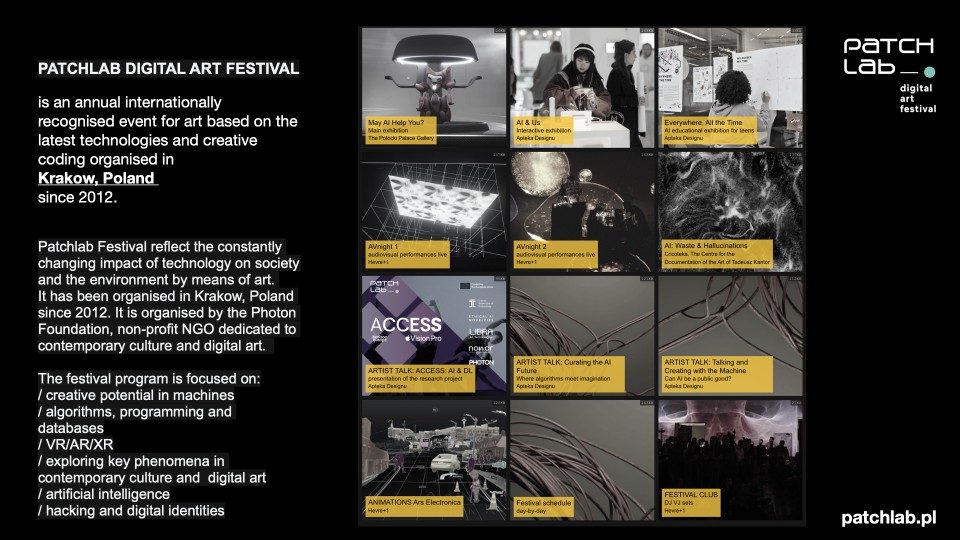
Elwira Wojtunik has placed particular emphasis on the pillars of mediation and education. In the face of rapid technological change, Patchlab aims to transform the public from mere consumers into enlightened actors. The festival aims to be an indispensable critical space, providing the conceptual and practical tools needed to understand current technologies and, potentially, influence their trajectories.
Finally, to round off the session, the audience was introduced to a Hungarian initiative to bring a brownfield site back to life with a digital arts festival on its premises: the Inota Festival.
Inota Festival (Hungary) – Creative festival on a disused industrial site
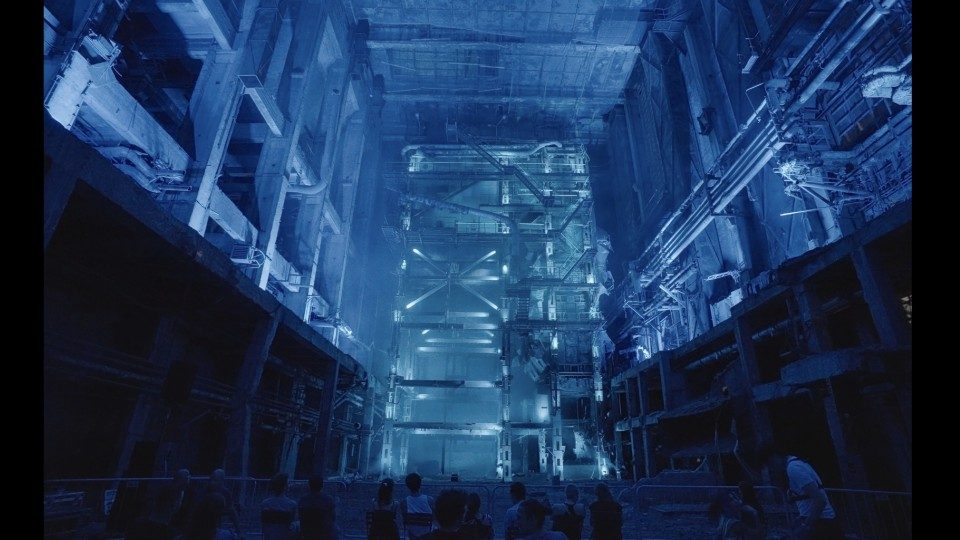
Mátyás Kálmán (co-founder and curator of the festival) offered an overview of theInota Festival – a festival he co-founded, held within the grounds of a disused former thermal power plant. He described the project as a reconversion of industrial heritage into a “powerhouse for music and visual arts”. The intervention highlighted the aesthetic power of the site, where monumental light installations (notably in the cooling towers) and techno music cohabit with the raw concrete architecture. He also opened a window on the future of content production, talking about his work with Promptmonsters.tv, a pioneering structure dedicated to artificial intelligence-assisted video creation.
Following an exploration of the diversity of the European digital art scene and how festivals are appropriating public space, immersive architecture (fulldome, Inota) and societal critique (Patchlab), the focus shifts to the third day. This will focus on the integration of digital technology within heritage and museum institutions, examining how these tools transform both internal production processes (AI, digital mediation devices in exhibitions) and dissemination strategies aimed at enhancing accessibility, logistical resilience and community engagement.
Thursday, December 4: MUSEUMS AND HERITAGE

Presentation of inspiring projects between the Musée des Confluences and Femme Fatale Studio by Cédric Lesec, Director of External Relations and Diffusion at the Musée des Confluences, and Thibault Jorge, Production Director and co-founder of Femme Fatale Studio.
As part of the ” Le temps d’un rêve ” exhibition, which welcomed 500,000 visitors, the museum wanted to explore the mystery of dreaming, an activity that occupies almost a third of human life. The duo presented a specific digital installation designed to meet a complex scenographic challenge: to create a large-scale dream film projected onto the ceiling, above the scenography, to evoke the dream state continuously and intermittently throughout the exhibition. Faced with budget constraints and the need to produce a long, spectacular film, the studio proposed an innovative approach, moving away from traditional animation (storyboards, illustrations) to adopt a constant visual flow generated by artificial intelligence. This method created a kind of “digital exquisite corpse”, an infinite flow of mental images and abstractions in perpetual metamorphosis. The end result was a perfect form of hallucination, capable of being both a highly personal vision of the dream and a universal representation suited to the vocation of the Musée des Confluences.
From Barcelona to the road: how the “la Caixa” Foundation (ESP) ensures the logistical resilience of its exhibitions.
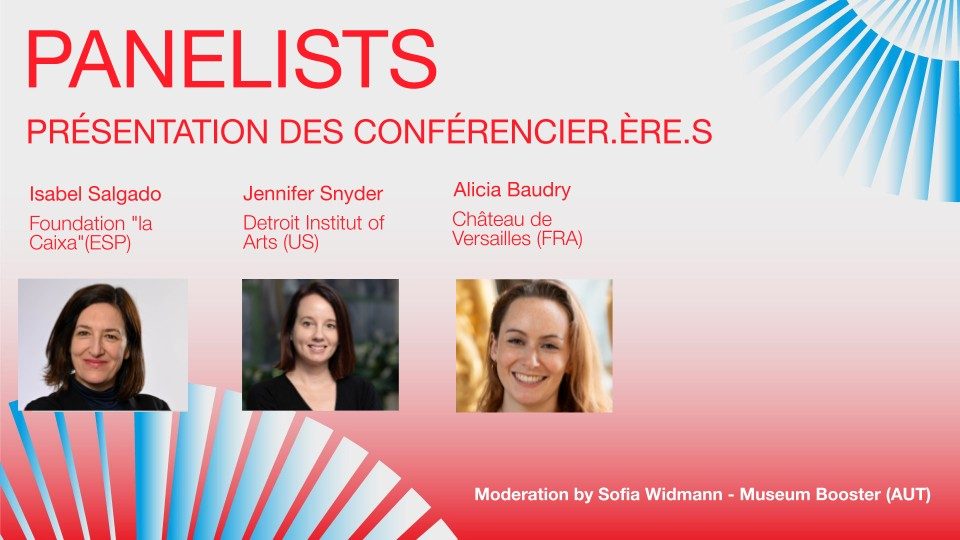
As Director of the “la Caixa” Foundation‘s Cultural Program, Isabel Salgado, Director of Exhibitions, Collections and Digital Projects at “la Caixa” Foundation, is driving a major cultural outreach strategy in Spain. Her mandate encompasses the management of a substantial physical network, including the CosmoCaixa science museum in Barcelona and ten cultural centers throughout the country. Alongside this physical presence, it is actively developing the free digital platform Caixaforum Plus, aimed at extending the accessibility of the foundation’s content beyond its walls. A notable part of its recent involvement has been dedicated to the experience derived from an immersive exhibition on nature, the fruit of a collaboration with Oasis immersion and National Geographic, whose initial launch took place in Montreal during COP15.
At the heart of the presentation were the logistical and technical challenges involved in managing a network of traveling exhibitions. She stressed the imperative of creating installations that are not only artistically and technologically ambitious, but above all scalable and easily transportable. The institution must guarantee the ability of projects to travel efficiently between its ten cultural centers to maximize their impact and reach with the public. This requirement arose from transparent feedback on a past challenge: an exhibition by the TeamLab collective, although acclaimed in Barcelona, had proved impossible to adapt for touring due to its technical complexity and rigid design.
For the new immersive nature project, the team adopted a completely rethought design and production approach to ensure its logistical success. Three key measures were implemented. Firstly, a modular design simplified set-up, dismantling and adaptation to the different spatial configurations of the centers. Secondly, a commitment to sustainable production and re-use was made to minimize ecological footprint and costs. The most significant innovation, however, is remote technical control (tele-maintenance): this sophisticated system enables technical problems to be diagnosed and resolved instantly and remotely, eliminating the need to deploy engineers to each site and guaranteeing the exhibition’s operational continuity. In conclusion, Isabel Salgado’s speech highlighted the delicate balance between artistic ambition and technical resilience, underlining the crucial importance of scalability in the “la Caixa” Foundation’s strategy of decentralized cultural dissemination.

Whether meeting industrial logistical challenges in Europe or strengthening social ties in the United States, the challenge remains the same: to take art out of its sacred walls and anchor it in everyday life. After exploring the challenges of technical scalability in Barcelona, we turn our attention to Detroit, where digital innovation is being used to promote a citizen’s emotional appropriation of heritage.
Art in the service of the community: the example of the Detroit Institute of Arts (USA)
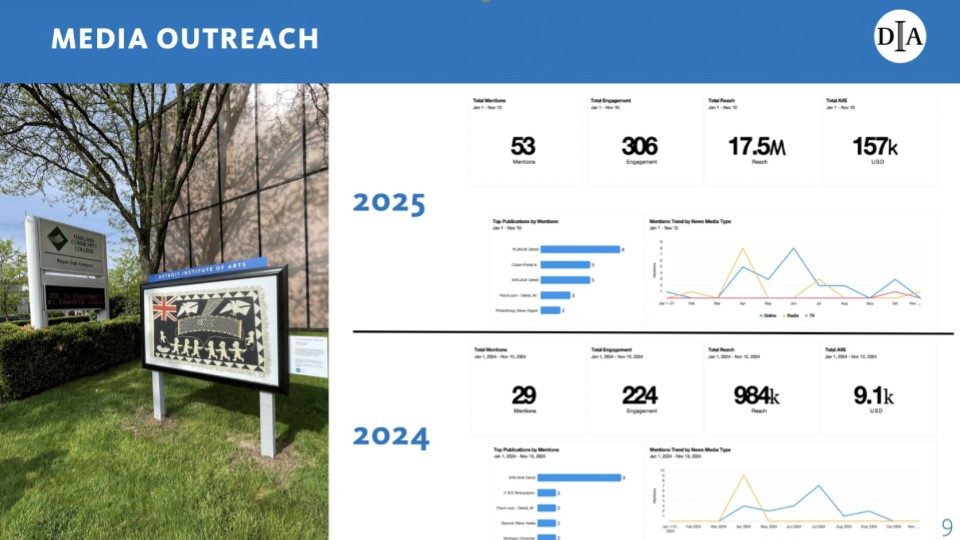
The Detroit Institute of Arts (DIA), through its Chief Digital Officer Jennifer Snyder, whose scope deftly covers “everything with pixels that isn’t art” within the institution, has vividly demonstrated how digital innovation can amplify community engagement. The museum initially capitalized on the success of its flagship project, “Inside Out”. This already popular program involves disseminating around 300 reproductions of high-quality artworks in public spaces – streets, parks, squares – in the local community, transforming the city itself into a vast open-air art gallery.
Noting the overwhelming support and palpable affection of the public for this physical accessibility initiative, Jennifer Snyder identified a strategic opportunity to add a digital dimension, but with a decidedly pragmatic and “low-tech” approach. Rather than investing in the development of a costly and potentially little-used mobile application, the team opted for the integration of simple QR codes. These codes, discreetly added to the labels accompanying each reproduction, lead not to an application, but to a streamlined and remarkably effective mobile web interface, capitalizing on the familiarity of Google Maps.
This digital solution proved to be a masterstroke. The interface, which is child’s play to use, allows users to be instantly geolocated. It then displays reproductions of nearby works and, in a playful way, suggests an itinerary to get to those of their choice. The simple act of walking around one’s own city is thus transformed into a veritable cultural and interactive “quest” or “treasure hunt”, encouraging exploration and active discovery.
The results of this engagement strategy were absolutely spectacular, exceeding all expectations. The initiative quickly went viral, amplified by the enthusiasm of local influencers who relayed the concept to their communities. The museum recorded an absolutely staggering 252% increase in overall engagement. In concrete terms, this impressive figure translates into a leap in impressions, from 100,000 to 17.5 million.
Beyond digital metrics, this project succeeded in weaving stronger emotional and physical bonds between residents and their artistic heritage. By bringing art to their doorstep and facilitating interaction with it, the DIA has concretized the powerful sense of ownership expressed by residents: “This is my museum, this is my community”. This approach is a perfect example of how simple, well-thought-out technology, far from complex gadgets, can create a profound and lasting cultural impact.
Beyond DIA’s successful community involvement, digital innovation requires us to reflect on the visitor’s state of mind and availability. The case of Versailles offers a striking contrast in this respect: while QR codes in Detroit stimulate walking and urban discovery, in situ virtual reality can sometimes be perceived as an additional cognitive burden for a public already saturated by the richness of physical heritage.
Palace of Versailles (FRA) – Adapting your distribution strategy to meet your audience’s needs
Alicia Beaudry, Digital Project Manager at the Palace of Versailles, presented “Versailles: The Sun King’s Garden“, an ambitious virtual reality experience designed to bring to life three vanished historic sites: the Menagerie (the royal zoo), the bosquet des fontaines d’Ésope and the Grotte de Téthys. Although the project has been rigorously validated by a scientific committee (right down to the shape of the topiaries and Louis XIV’s costumes), Alicia shared one observation: ticket sales are below expectations.
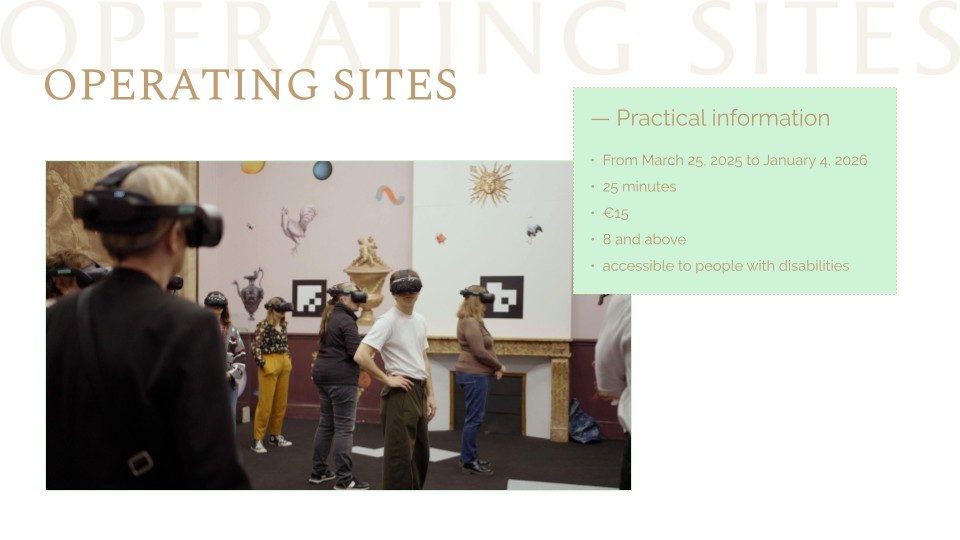
She explains this tendency in terms of “museum fatigue” and the location of the experience. After wandering through the Galerie des Glaces, the gardens, the Hameau and the stables, visitors may receive these proposals with a certain amount of cognitive fatigue. In response to a suggestion from the public, the Palace confirmed that moving this experience outside the walls, for example to Paris, might be an ideal solution to allow the public to discover it “on their own”, perhaps over a coffee, even before their physical visit to the Palace.
The challenge faced by Versailles reminds us that technology, no matter how perfect, cannot impose itself if it does not meet with human availability. This return to the human factor is also the common thread running through the Belvedere’s analysis. Paradoxically, it was the Viennese museum’s digital unit that chose to forgo digital tools in order to conduct field surveys, revealing that the success of a modern institution now depends on its ability to offer moments of relaxation and conviviality, far beyond mere artistic mediation.
Social impact assessment at Belvedere: beyond art, the meeting space. (AUT)
A recent analysis has highlighted the innovative approach of the Musée du Belvédère presented by Constanze Mitterhuemer, with some 2 million annual visitors, in assessing its societal impact. The study specifically explored the application of the “Value Realization Process” theory developed by researcher John Falk, to quantify the museum’s contribution to the social well-being of the local community.

The focal point of this evaluation was the monthly ” Free Friday Nights ” event, a free night-time opening initiative designed exclusively for local residents.
It’s notable that the team in charge of the evaluation, paradoxically its “digital” unit, deliberately favored a decidedly analog survey methodology. Instead of using passive digital tools like QR codes to collect satisfaction ratings, the museum deployed teams of interviewers in the field. These teams conducted face-to-face interviews with visitors, a strategy adopted to guarantee not only the quality, but also the diversity and depth of the feedback obtained.
The results of this survey revealed several unexpected demographic and motivational characteristics of the target audience. The event attracts a significantly younger segment of the population, mainly in the 20-30 age bracket, and a majority of women. The main stated motivation for attending these evenings was not access to the art collections, but an active search for socialization. Significantly, this audience expressed a desire not for an increase in the classic artistic or cultural offering, but rather for an expansion of elements facilitating social interaction and entertainment, such as music, food and drink.
This discovery empirically reinforces the perception of the museum as transcending its traditional function as a curator of art to assert itself as a vital space for encounters and the enhancement of social well-being within the community. The Belvedere experience thus demonstrates the relevance of targeted, qualitative evaluation in understanding the real value that cultural institutions bring to their contemporary audiences, going beyond mere attendance.
Thursday’s session, focusing on museums and heritage, highlighted how cultural institutions are pushing back physical walls through innovation (AI for creation, modularity and remote maintenance for itinerancy, low-tech for community engagement) and redefining their role as spaces for socialization (Belvedere). These reflections on the hybridization of formats and adaptation to audience expectations initiated Friday’s discussions, which focused on Creative Labs and the challenges posed by the articulation between art, science and digital technologies, particularly in terms of the accessibility of complex data and the fight against the digital divide.
Friday, December 5: ARTS, SCIENCE AND CREATIVE LABS

This panel highlighted a tension between the growing complexity of science and the need to make it accessible, even desirable. Speakers showed how “Creative Labs” are attempting to bridge the gap between the rigor of data and the emotion of experience.
Developing ethical and participative mediation projects to ensure their sustainability. Universcience (France)
With the Cité des Bébés, Anne Prugnon, Director of Publishing and Transmedia at Universcience, was faced with an institutional paradox: how can a science and technology museum advocate “zero screen” and “low-tech”? The challenge was to define an innovation that was not technological, but environmental and cognitive. The central issue was mental and plastic health: protecting developing brains from digital overexposure while creating a stimulating space.

The other major challenge was radical eco-design (zero plastic, bio-sourced materials) in a museum sector that is often greedy for ephemeral resources. The project had to prove that “frugality” was not a regression, but an advanced form of design, forcing the institution to rethink its modes of production to align itself with today’s ecological imperatives.
The question of visualizing the invisible was then addressed by the Technical Museum of Sweden.
Making the abstraction of Big Data intelligible – Tekniska Museet (Sweden)
The “Wisdome” project responds to a crisis in scientific representation: today’s data (climate, astrophysics) have become too complex and massive to be understood via 2D graphics or text. The challenge facing Jesper Wallerborg, technical manager at Tekniska Museet, is one of “translation”: how to transform terabytes of raw data into an intuitive visual experience for the general public, without betraying scientific rigor?

The technical and democratic challenge is considerable: to use the same visualization tools as researchers (OpenVis) for the public. The challenge is to enable citizens to “see” science in the making, to navigate in the infinitely small or large, to combat scientific skepticism. The aim is to move from popularization (simplification) to visualization (immersion in complexity).
How does a digital arts center, while aiming to make technology a fundamental right and a tool for equity, manage to reconcile its mission of educating and raising awareness of digital culture for all audiences with the requirement to use digital creation as a concrete lever for innovation in the face of societal challenges, without the emphasis placed on innovation creating new forms of exclusion or marginalizing the populations furthest removed from technology? The MEET Digital Culture Center has shed light on this question.
Digital acculturation and the “Digital Divide” MEET Digital Culture Center (Italy)
Alessia Bimonte, Event Production Manager at the MEET Digital Culture Center Alessia Bimonte, in charge of event production at the MEET Digital Culture Center, described a problem specific to Italy: a marked lag in the population’s digital culture. MEET’s challenge is not just artistic, but societal: how can a physical venue combat illiteracy and the fear of technology? The challenge is to demystify digital technology (“it’s not magic, it’s culture”) by taking it away from individual screens and turning it into a shared experience.
The creation of a physical “home” for digital culture responds to the paradox of dematerialization. The challenge is to prove that digital technology needs walls, encounters and a human presence to become meaningful. In this way, MEET is positioned as a necessary third place to “humanize” technology and encourage critical creativity rather than passive consumption.

Finally, Ars Electronica explored the future of collective interaction in immersive spaces. The festival explored how virtual reality (VR), augmented reality (AR) and mixed environment technologies are transforming communication and collaboration. The focus was on the search for new forms of shared presence and collective storytelling, questioning the social and ethical impact of these mutations on democracy, education and culture.
Breaking the isolation of Virtual Reality – Ars Electronica (Austria)
Michael Mondria, Managing Director of Ars Electronica, has identified a major flaw in current immersive technologies (such as VR headsets): user isolation. The challenge of Deep Space 8K is to restore the social dimension of the digital experience. How can we enable a group of 100 people to experience the same immersion simultaneously, and interact with the content together?

The technological challenge of 8K and laser tracking is not an end in itself, but a response to a need for scientific precision and bodily interaction. The challenge is to create an invisible interface that enables the audience to become an actor (through movement and displacement) rather than a seated spectator. The aim is to transform the projection space into a space for debate and collective exploration, where technology fades into the background in favor of group dynamics.

This sixth edition of NUMIX LAB, with its four What’s News? sessions, provided a panorama of Europe’s fast-changing immersion and digital scene, characterized by a hybridization of formats and constant adaptation to audience expectations. Discussions converged on the idea that technological innovation is no longer an end in itself, but a strategic lever in the service of accessibility (modular roaming, low-tech engagement), the democratization of scientific knowledge (Big Data visualization) and the strengthening of social ties, as cultural institutions increasingly redefine themselves as meeting places and well-being centers for their communities.
Vincent MATHIOT